This is an archive of information released in the past.
Disclaimer: It may contain broken links or outdated information. Some parts may not function in current web browsers.
*Visit https://humans-in-space.jaxa.jp/en/ for the latest information.





H-II Transfer Vehicle KOUNOTORI (HTV)
HTV Components
The H-II Transfer Vehicle (HTV) consists of two logistic carriers, the Pressurized Logistics Carrier (PLC) and the Unpressurized Logistics Carrier (ULC), which also includes the Exposed Pallet (EP), as well as an Avionics Module and a Propulsion Module.
The Japanese Experiment Module (JEM), known as "Kibo," is equipped with antennas, reflectors and a Proximity Communication System (PROX) that enables inter-orbit communication with the HTV as the HTV approaches the ISS.
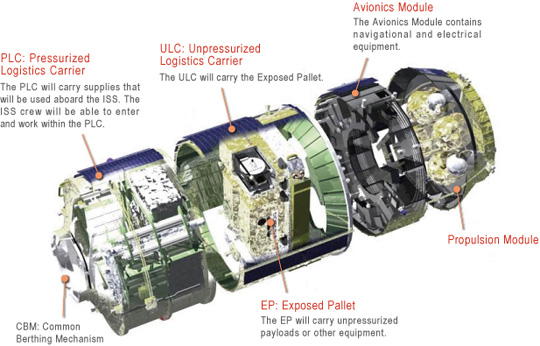
Configuration Diagram
Pressurized Logistic Carrier
The Pressurized Logistics Carrier (PLC) carries cargo such as International Standard Payload Racks (ISPRs), drinking water and clothes that will be used aboard the ISS. The PLC's internal air pressure is controlled and maintained at one atmospheric pressure (1atm). While the HTV is berthed with the ISS, the ISS crew can enter the PLC to unload the supplies. After the supplies are unloaded, waste material will be loaded. The ISS crew members enter and exit through the HTV's berthing port that is equipped with the Common Berthing Mechanism (CBM).
Unpressurized Logistic Carrier
The Unpressurized Logistics Carrier (ULC) carries unpressurized cargo loaded on the Exposed Pallet (EP).
Exposed Pallet
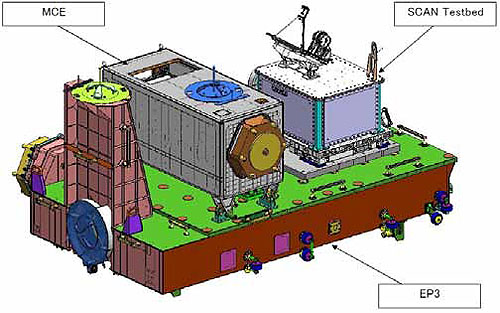
Unpressurized payloads and the ISS battery Orbital Replacement Units (ORUs) are loaded on the Exposed Pallet (EP). There are two types of Exposed Pallets: Type I and Type III.
Type I can carry payloads that will be used on Kibo's Exposed Facility (EF). Two or three Kibo Exposed Facility Payloads per flight can be delivered. This pallet will be attached to the EF.
Type III can carry the US unpressurized ORUs, such as the battery ORUs. This pallet will be attached to the station's Mobile Base System (MBS). Up to six battery ORUs can be delivered.

Type I pallet
Type III pallet
Avionics Module
The Avionics Module contains navigational and electrical systems used for HTV's navigation control, communication and supplying power. The Avionics Module enables the HTV flight to navigate by receiving commands sent from the ground or to navigate by HTV autonomous flight systems. In addition, the Avionics Module distributes power to its each component.
Propulsion Module
The Propulsion Module has four propellant tanks. The HTV's thrusters generate propulsion for orbital adjustment or attitude control. There are 32 thrusters installed on the HTV.
Proximity Communication System (PROX)
The Proximity Communication System (PROX), which is installed on Kibo, consists of a PROX antenna, a PROX-GPS antenna, PROX communication equipment and a Hardware Command Panel (HCP). With the exception of the PROX antenna, the PROX-GPS antenna and the HCP, the PROX is installed in the JEM Pressurized Module.
When the HTV approaches close to the ISS, the PROX antenna initiates communications with the HTV. This antenna contains GPS receivers. Through the PROX, the ISS's orbital location and speed are immediately relayed to the HTV. At the same time, data from the HTV are relayed to the ISS. In addition, the antenna relays commands sent from the ground to the HTV.
Reflector
The reflectors are installed on the nadir (bottom) side of Kibo. The reflectors reflect the lasers that are beamed from the HTV's Rendezvous Sensor (RVS) during the HTV close proximity operation.
| Copyright 2007 Japan Aerospace Exploration Agency | Site Policy |