|
||||||
 | ||||||
 |
 |
FEASIBILITY STUDY OF LIQUID BRIDGE SURFACE DEFORMATION IN HIGH PRANDTL NUMBER MARANGONI CONVECTION EXPERIMENT CELL
Kazunori Kawasaki1, Kazuo Ohta1, Kazunori Matsuo1,and Shinichi Yoda2
1IHI Aerospace Co., Ltd, 900 Fujiki, Tomioka-shi,Gunma, 370-2398, Japan
2National Space Development Agency of Japan, Sengen 2-1-1, Tsukuba-city, Ibaraki 305-8505, Japan
- 1. INTRODUCTION
- 2. MEASUREMENT METHOD
- 3. FOCAL POINTS OF DEVELOPMENT
- 4. DEVELOPMENT PLAN
- 5. CONCLUSION
Feasibility study of applicable liquid bridge surface deformation measurement for on-going High Prandtl Number Marangoni Convection Experiment Cell development on Japanese Experiment Module (Kibo) was conducted. Three surface deformation measurement method, based on MIDM (Microscopic Imaging Displacement Meter) suggested by Professor Nishino, was proposed.. The focal points of development and development plan for each surface deformation measurement method was studied.
To develop the numerical analysis method for marangoni convection, high accuracy data acquisition from the experiment is necessary to compare to the analysis results. Further more, the importance of surface deformation measurement is pointed out on Marangoni Convection Modeling Research. At present, the marangoni convection Experiment Cell for high prandtl number liquid (silicon oil) used for Kibo is under development.
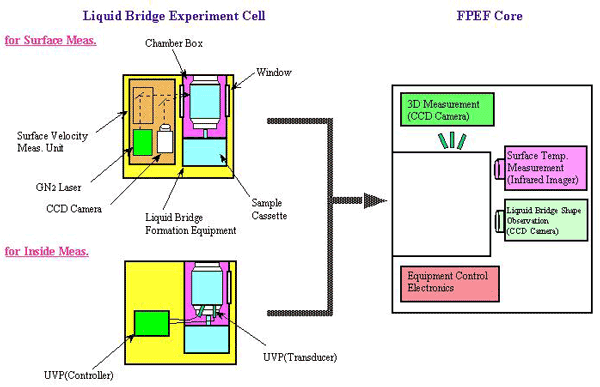
The Experiment Cell consists of the liquid bridge formation equipment and measurement device. 30mm and 50mm diameter liquid bridge can be created using liquid bridge formation equipment. There are two kinds of Experiment Cell. One is the Experiment Cell for liquid bridge surface measurement which has surface velocity measurement unit and the other is for liquid bridge inside measurement which has Ultrasonic Velocity Profile(UVP).
The Experiment Cell will be installed in FPEF Core on orbit. The following measurements on each Experiment Cell will be achieved using the measurement device of the Experiment Cell and FPEF Core. Concept of Experiment Cell is shown in Fig.1-1.
- For liquid bridge surface measurement
- 3-dimension flow field measurement (by CCD camera of FPEF Core)
- Surface temperature measurement (by Infrared Imager of FPEF Core)
- Surface flow velocity measurement (by Photochromic method of Experiment Cell)
- Observation of liquid bridge shape (by CCD camera of FPEF Core)
- For liquid bridge inside measurement
- 3-dimension flow field measurement (by CCD camera of FPEF Core)
- Surface temperature measurement (by Infrared Imager of FPEF Core)
- Flow velocity measurement of liquid bridge interior (by UVP of Experiment Cell)
- Observation of liquid bridge shape (by CCD camera of FPEF Core)
Objective of this year is to study the application of liquid bridge surface deformation measurement to on-going high prandtl number marangoni convection Experiment Cell development. We have studied surface deformation measurement methods, focal points of development and development plan of each measurement method.
Fig. 1-1 Concept of Experimental Cell
2.1 Assumptions
To study application of surface deformation measurement to on-going Experiment Cell development, assumptions are as follows.
- On-going Experiment Cell development with surface flow velocity measurement is modified for measuring surface deformation.
- The following measurements will be conducted on the modified Experiment Cell.
- 3-dimension flow field measurement
- Surface temperature measurement
- Surface deformation measurement
- Observation of liquid bridge shape
- Base method for surface deformation measurement is MIDM.
2.2 Surface deformation measurement methods
The following three measurement methods based on MIDM are planned.
- Microscopic surface deformation measurement method using Hi-vision camera
- Microscopic surface deformation measurement method using CCD camera
- Laser surface deformation measurement method
2.2.1 Microscopic surface deformation measurement method using Hi-vision camera
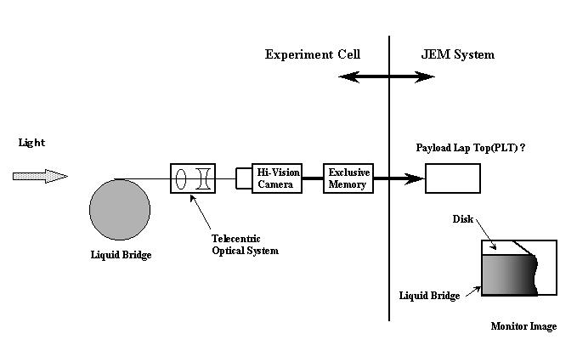
Concept of this method is shown in Fig.2-1. Main performance is shown in Table 2-1.
Deformation of liquid surface will be recorded by Hi-vision camera through telecentric optical system. Because of non-existing interface for Hi-vision camera in Kibo, an exclusive memory must be prepared to record an image in Experiment Cell. Communication interface between the exclusive memory and Kibo must be established to down-link an image for real-time monitor. An estimated recording time of the exclusive memory will be approximately 100 seconds due to envelope budget in Experiment Cell. Estimated down-link time will be approximately 3 hours due to capacity of the existing communication line of Kibo, if the communication interface is to be established.
2.2.2 Microscopic surface deformation measurement method using CCD camera
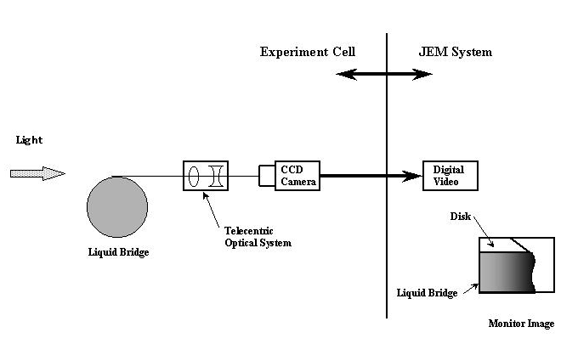
Concept of this method is shown in Fig.2-2. Main performance is shown in Table 2-1.
This method replaces Hi-vision camera of paragraph 2.2 to CCD camera. Therefore, exclusive memory is not required and existing communication interface for CCD camera on Kibo can be used. Though the resolution of CCD camera is less than Hi-vision camera, it is confirmed that surface deformation can satisfactorily be measured from the ground experiment conducted by Professor Nishino.
2.2.3 Laser surface deformation measurement method
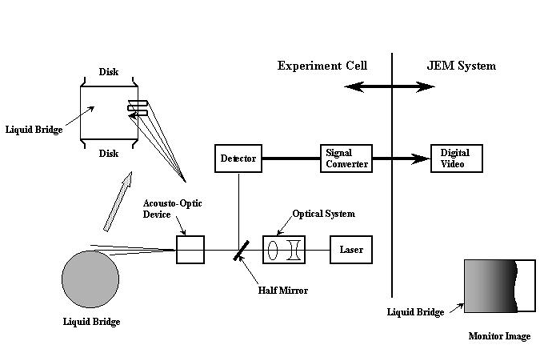
Concept of this method is shown in Fig.2-3. Main performance is shown in Table 2-1.
Laser beam focused through the optical system is lighted to liquid bridge through the acoustic-optical device. Laser beam can cyclically search the edge of liquid bridge with the acoustic-optical device at high speed. Reflection wave from liquid bridge is detected by a detector. The strength of reflection wave is transformed into electrical signal by signal conditioner, and recorded to existing video system.
2.3 Location of surface deformation measurement
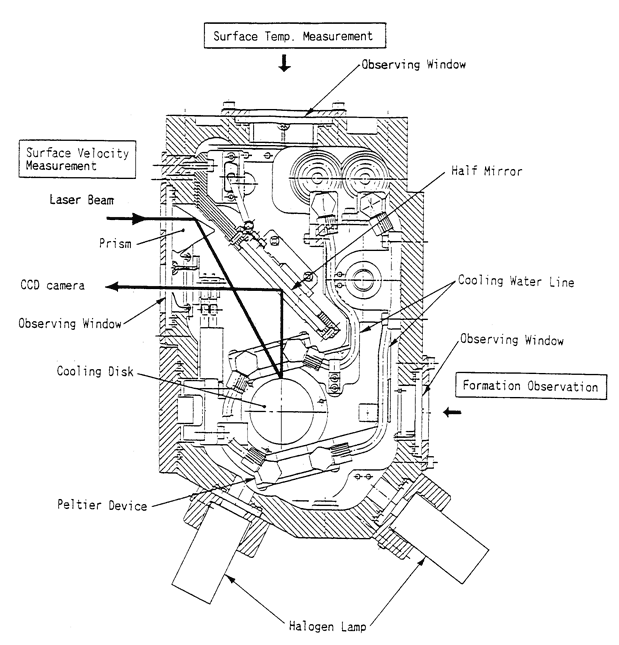
Cross diagram of on-going liquid bridge formation equipment development is shown in Fig. 2-4.
In this equipment, surface temperature of liquid bridge can be measured from the top of the figure and surface flow velocity of liquid bridge can be measured through the prism from the left of the figure. Surface temperature measurement and surface flow velocity measurement is in the same location of liquid bridge. The lighting for 3D flow field measurement and surface flow velocity measurement is from the bottom of the figure.
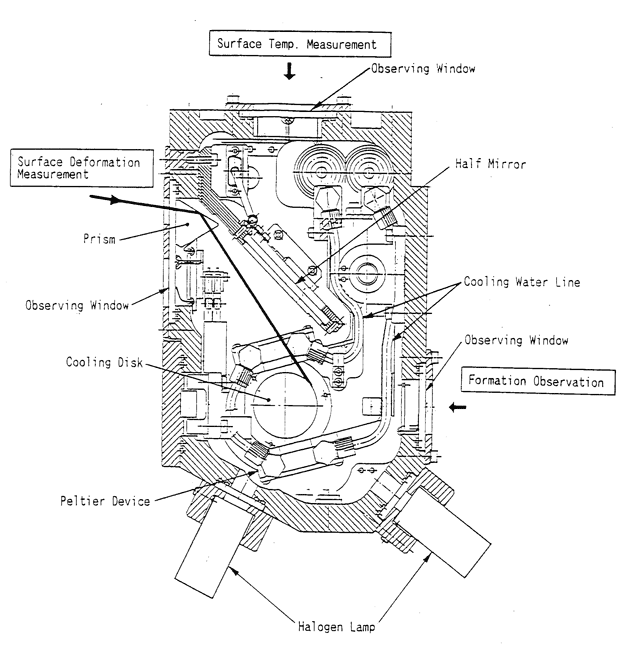
For surface deformation measurement, optical path is from the left of the figure. Surface temperature measurement and surface deformation measurement is not in the same location of liquid bridge, due to the usage of same on-going liquid bridge formation equipment. (see Fig. 2-5)
Fig. 2-1 Surface deformation measurement method using Hi-vision camera
Fig. 2-2 Surface deformation measurement method using CCD camera
Fig. 2-3 Laser Surface deformation measurement method
Table 2-1 Comparison of surface deformation measurement method Hi-Vision Camera
CCD Camera
Laser
Field of View
approx. 0.3 x 0.5 (mm)
approx. 0.3 x 0.5 (mm)
approx. 0.5 x 0.5 (mm)
Resolution
approx. 0.25 (mm)
approx. 0.5 (mm)
approx. 1.0 (mm)
View Range
(Liquid Bridge Axis)0 ~ 80 (mm)
0 ~ 80 (mm)
0 ~ 80 (mm)
View Location
Different Surface from Temperature Measurement
Sampling Rate
30 (Hz)
30 (Hz)
Scan freq. : 15 (MHz)
Search time / cycle : 1/60 (sec)Recording
Exclusive Memory
Digital Video Tape
Digital Video Tape
Safety
Satisfactory within On-going Experiment Cell development
Development Cost
Medium
Low
High
Fig. 2-4 Liquid bridge formation equipment (in process)
Fig. 2-5 Liquid bridge formation equipment for surface deformation measurement
3. FOCAL POINTS OF DEVELOPMENT
Focal points of development for each surface deformation measurement method are as follows.
3.1 In case of using Hi-vision camera
An exclusive memory is required due to non-existing interface for Hi-vision camera described in paragraph 2.2. If the exclusive memory is installed in existing envelope, an estimated recording time is approximately 100 seconds. Therefore, study of enlarging the envelope is needed. Coordination with Kibo system for down-link of exclusive memory is also needed.
3.2 In case of using Hi-vision camera and CCD camera
Parallel lighting along liquid bridge to define edge shape of liquid bridge is needed. However, there is envelope limitation for parallel lighting in existing liquid bridge formation equipment. The confirmation of 3D observation and surface deformation measurement compatibility with existing lighting unit and/or study of enlarging the envelope is needed.
3.3 In case of using laser
Matching of laser reflection intensity and detector sensitivity is needed.
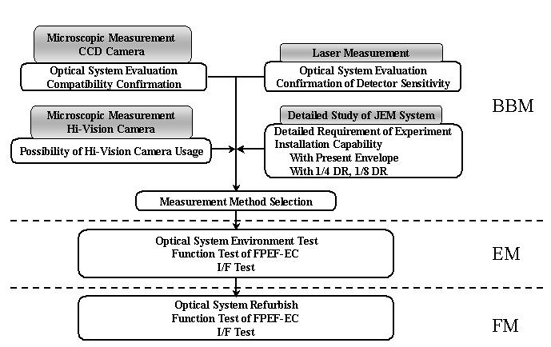
Development flow is shown in Fig. 4-1.
In BBM(Bread Board Model) phase, tests of compatibility with existing lighting system described paragraph 3.2 and matching of laser reflection intensity and detector sensitivity described paragraph 3.3 shall be conducted to judge the effect of these methods. At the same time, possibility of Hi-vision camera usage on Kibo in the future shall be investigated. Study of detailed experiment requirements and study of installation capability (present envelope or 1/8DR or 1/4DR) shall be conducted. As the result of these studies, optimum surface deformation measurement method shall be selected.
In EM(Engineering Model) phase, all components of Experiment cell shall be manufactured and various function tests and environment tests shall be conducted. Confirmation of compatibility with FPEF Core shall be conducted on interface test.
In FM(Flight Model) phase, optical system shall be refurbished. After reassembly, the same function tests and interface test as EM phase shall be conducted.
In result of this study in regard to liquid bridge surface deformation measurement method, focal points of development for each measurement method is defined, and development plan to select measurement method can made. For further studies, following items shall be clarified.
- Possibility of Hi-vision camera usage in Kibo
- Necessity of surface temperature and surface deformation measurement in the same location of liquid bridge
- Expected surface deformation for 30mm dia. and 50mm dia. liquid bridge in order to decide target resolution.
|
|
|

|