|
||||||
 | ||||||
|
|
|
|
EXPERIMENTAL STUDY OF THERMOCAPILLARY FLOW IN THE HALF-ZONE LIQUID BRIDGE OF LOW PRANDTL NUMBER FLUID
Katsuhiko Takagi1, Masahiko Ohtaka1, Hidesada Natsui2, Tatsuya Arai1, and Shinichi Yoda1
1National Space Development Agency of Japan, Sengen 2-1-1, Tsukuba-city, Ibaraki 305-8505, Japan
2Advanced Engineering Services Co. Ltd., Takezono 1-6-1, Tsukuba-city, Ibaraki 305-0032, Japan
- ABSTRUCT
- 1. INTRODUCTION
- 2. TEMPERATURE FLUCTUATION MEASUREMENT
- 3. PERFORMANCES OF NEW EXPERIMENT CHAMBER
- 4. DEVELOPMENT OF MEASURING TECHNIQUE OF FLOW FIELD AND MANUFACTURING TECHNIQUE OF TRACER
Oscillatory thermocapillary flow of low Prandtl number fluid in the half-floating zone was experimentally studied under normal gravity. Measurement technique in surface temperature of a liquid bridge of tin as a test fluid was developed. Theoretical investigation of radiation energy from molten tin showed that PbS photo detector can measure proper wavelength range with high radiation energy, combined with use of CaF2 optical pass filter. It was confirmed that the selected radiation thermometer had temperature resolution that was smaller than amplitude of temperature fluctuation of oscillatory flow.
The new measuring technique made it possible to observe surface temperature fluctuations successfully by using the ex-chamber in which CaF2 optical pass filter has not been installed. The periodic fluctuation continued approximately 100sec, then damped gradually, suggesting that reduction in temperature dependence of surface tension be caused by oxidation of molten surface. A temperature difference of 7.6K was observed for onset of the periodic flow, which was almost good agreement with the numerical result with 7.1K. It should be noted here the second bifurcation point, which has never observed yet, could be detected by the present experiments.
Considerations for surface science of tin led us to design of unique experiment apparatus where clean surface of molten tin was able to obtain and sustain during an experiment. Ar+ ion etching method was applied to remove residual surface oxides, and effectiveness of the etching was confirmed by the installed ion gun that was designed for surface cleaning. Prevention of further oxidation under vacuum condition of about 10-6Pa during one experiment was experimentally verified by in situ measurements of surface tension of molten tin.
Novel visualization technique (3D-UV) of flow field measurements for liquid metals using ultrasonic transducer with high heat resistance is currently under development for the experiments. It was concluded that the first bifurcation point could be detected precisely by 3D-UV technique with the consideration of the experimentally predicted performances such as a resolution, a minimum size of a tracer, and a signal processing method. 3D-UV can visualize flow field of the liquid bridge in which the aspect ratio is a range of 2.3 (a=1.5mm) to 0.8 (a=5mm). The visualization technique requires development of unique balloon-like tracer also. It was confirmed that the balloon tracer with good sphericity could be actually manufactured by electroless plating of Ni over surface of Shirasu-balloon, which is an expanded volcanic particle, subsequently by electrolysis plating of Fe.
Thermocapillary flow would be transitioned from axisymmetric steady to 3D oscillatory flow as the temperature difference increased. Figure 1-1 shows an overview of the transition behavior of thermocapillary flow. In high Prandtl number fluids, it was proved that a transition from axisymmetric to 3D oscillatory occurs beyond the onset point. On the other hand, it was numerically predicted that thermocapillary flow in a low Prandtl number had two transition points: that is, a flow transition from axisymmetric to 3D steady will occur at the first bifurcation point, and a transition from 3D steady to 3D oscillatory at the second bifurcation. However, the critical Marangoni number has been rarely determined by an experimental approach in low Pr number fluid successfully. The prediction needs to be proven experimentally.
Fig. 1-1 Transition phenomena of thermocapillary flow
Most previously documented experiments have dealt with transparent fluid of a high Pr number in ambient temperature; it is easy to handle such a fluid and to observe its flow field. In contrast, experiments with low Pr number fluids, which are generally molten metals and alloys, have been few. This is due to following reasons:
- (1) Low Pr number fluids are opaque. The flow field cannot be observed by means of a visual ray.
- (2) Surface of base metals is easily oxidized above its melting point. An oxidation film suppresses thermocapillary flow.
- (3) High temperature at which metals are in liquid state makes it difficult to handle.
Figure 1-2 shows the influence of the Prandtl number on the critical Reynolds number obtained by linear stability analysis and direct numerical simulation. In the case of tin with Pr number of 0.01, 5.0mm in height, and unity in aspect ratio, the temperature difference at the first and the second bifurcation point is about 1.6K and 5.3K, respectively. These values are much smaller compared to those for high Pr number materials.
Fig. 1-2 Pr number versus critical Reynolds number in low Prandtl number
Table 1-1 summarized the previous experiments using low Pr number fluid. It should be noted that most experiments were carried out for a purpose concerning a crystal growth research, that is, the objectives focused on whether oscillatory flow would produce impurity in striation during crystal growth. To date, few observations and measurements of flow and temperature fields have been conducted in low Pr number materials.
Table 1-1 Previous experiments using low Prandtl number fluids Year Title Author General Description Paper Experiment 1983 Experiment on the thermocapillary convection of a mercury liquid bridge in a floating half zone J.H. Han, W.R. Hu Liquid bridge of mercury was used. Critical Ma was obtained by detecting surface deformation. Journal of crystal growth 169(1996)129-135 1g 1989 The Floating-Zone Growth of Ti3Au and Ti3Pt Y. K. Chang Ti3Pt crystal was used. Surface striations was observed due to Marangoni convection. Journal of crystal growth 62(1983)627-632 1g 1990 Floating zone growth of silicon under microgravity in a sounding rocket A. Eyer, R. Nitsche Si crystal was used. Surface striations was observed due to Marangoni convection. Journal of crystal growth 71(1985)173-182 mg 1990 Transition from steady to time-dependent Marangoni convection in partially coated silicon melt zone A. Croll, R. Nitsche Si crystal was used. Surface striations was observed due to Marangoni convection. Critical Ma was 100-200. Proc. VIIth European Symposium on Materials and Fluid Sciences in Microgravity, ESA SP-295 1g, mg 1990 Analysis of periodic non-rotational W striations in Mo single crystals due to nonsteady thermocapilary convection M. Jurisch, W. Loser W doped Mo crystal was used. Diameter dependence of critical Ma was obtained. Journal of crystal growth 102(1990)214-222 1g 1996 Surface temperature oscillations of a floating zone resulting from oscillatory thermocapillary convection M. Jurisch Mo and Nb crystal was used. Surface striation and surface temperature fluctuation was measured. The frequencies by both measurements agreed. Electron beam heating facility was used. Journal of crystal growth 102(1990)223-232 1g 1996 Experimental and numerical studies of thermocapillary convection in a floating zone like configuration M. Levenstam, M Andersson Si crystal was used. Temperature fluctuations near free surface was measured. Temperature fluctuation was seen. Numerical calculations were conducted. Journal of crystal growth 158(1996)224-230 1g 1996 Thermocapillary convection in a low-Pr material under simulated reduced gravity M. Cheng, S. Kou Molten Si was used. Temperature fluctuation on free surface was measured by pyrometer. At Ma of 6200; temperature difference of 50K, oscillation 0.07Hz and 4K in amplitude was observed. Proc. of 4th microgravity fluid physics & transport phenomena conference, 1998 1g 1998 Thermocapillary convection in a low-Pr material under simulated reduced gravity conditions Y. Tao, S. Kou Molten tin was used. Temperature fluctuation was measured by T/C. At temperature difference of 85K, oscillation of 5Hz and 1.3K in amplitude was observed. Proc. of 2nd microgravity fluid physics & transport phenomena conference, 1996 1g 1998 Temperature fluctuations of the Marangoni flow in a liquid bridge of molten silicon under microgravity on board the TR-IA-4 rocket S. Nakamura, T. Hibiya Molten Si was used. Temperature fluctuation near free surface was measured by T/C. At melting process, 0.1Hz of temp. fluctuation was observed. In 1g, 0.2Hz was obtained. Journal of Crystal Growth 186(1998) 85-94 1g, mg
The overall purpose of the present study is to understand transition phenomena in molten materials by means of an experimental approach and comparative study with the numerical works in this research group. In Japanese fiscal year of 1998, we have carried out the preliminary works which have mainly comprised selection of the fluid (i.e. molten tin) and the sustaining material for the liquid bridge (i.e. iron), preparation of the experimental devices, and measurements of surface temperature fluctuation of molten tin. These are described in the previous issue in detail. However, reproducibility of the surface temperature fluctuations obtained was insufficient. This is mainly due to low sensitivity of the installed measurement system of surface temperature and surface oxidation of molten tin during an experiment.
In 1999, measurement technique of surface temperature has been developed and the new technique has made it possible to observe surface temperature fluctuations of molten tin successfully near the second bifurcation point. Consideration concerning surface science of tin has led us to design of unique experiment apparatus where clean surface of molten tin has been able to obtain and sustain during an experiment. The new chamber has been constructed with co-operative works by Sukegawa Electric Co. Ltd., and performances of the chamber have been already confirmed. Novel visualization technique of flow field measurements for molten tin using ultrasonic transducer with high heat resistance is currently under development by consignment works to Toshiba Co. We can conclude that the first bifurcation point will be detected by this technique from the experimentally predicted performances such as a resolution, a minimum size of a tracer, and a signal processing method by the consignment works. The visualization technique requires development of unique balloon-like tracer also. The development is carrying out by collaboration with Kagoshima Prefectural Institute of Industrial Technology, in which the tasks for NASDA partly consign to NTT Advanced Technology Co. The surface tensions of molten tin in the experiment chamber have been studied by in site measurements. This study is carrying out by collaboration with Kyushu Institute of Technology and will lead to understanding the oxygen partial pressure dependency of s and sT of molten tin.
Many works have been done in this year, and we will be able to prove the flow transition from 3D steady to oscillatory in low Pr number fluid in the near future.
2. TEMPERATURE FLUCTUATION MEASUREMENT
A measurement result of surface temperature oscillation observed by thermviewer has been reported in the previous report, however, no definite temperature oscillation was observed by some experiments performed for confirmation of reproducibility of the observed result under same conditions. Except for quenching oscillatory thermocapillary flow by surface contamination, one of the reasons for not observing temperature oscillation is insufficient performances of the thermviewer for detecting radiation from cylindrical surface with very low emissivity. Therefore, Selection of radiation thermometer was investigated again and made correction by applying Japan Industrial Standard for radiation thermometer.
Fig. 2-1 Estimation of radiation energy detectable by available pyrometers
Theoretical radiation energy was calculated at a constant emissivity by using Planck equation for reinvestigation of radiation thermometer (Fig. 2-1). PbS photo detector can detect proper wavelength range (2.0~2.8mm) with high radiation energy, combined with use of CaF2 optical pass filter, for the low Pr experiment. Moreover, the PbS photo detector has sensitivity approximately ten times higher than that of the HgCdTe which was the selected detector for previous measuring system (Fig. 2-2). It was concluded that PbS photo detector (IMPAC Electronic GmbH, IP10/MB5) was optimum measuring instrument and surface temperature data with fine signal to noise ratio was expected by this system. The selected radiation thermometer had temperature resolution (0.24K) that was smaller than amplitude of temperature fluctuation at oscillatory thermocapillary flow by applying Japan Industrial Standard for radiation thermometer (Fig. 2-3).
Fig. 2-2 Detection sensitivity of photo detectors(PbS&HgCdTe)
Fig. 2-3 Performance test results of IMPAC IP10/MB5
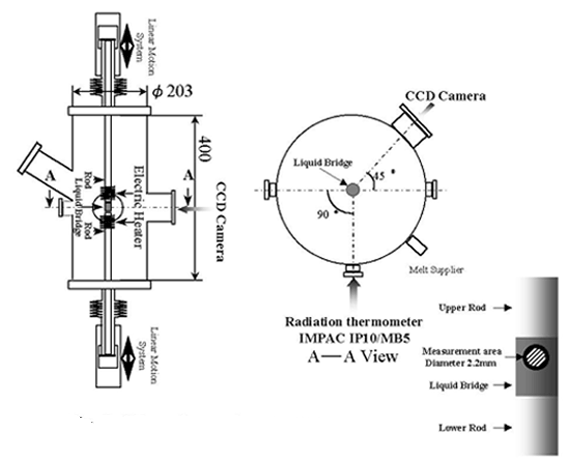
The new measuring technique made it possible to observe surface temperature fluctuations of molten tin successfully near the second bifurcation point by using the ex-chamber in which CaF2 optical pass filter has not been installed (Fig. 2-4). The present object taking in this experimental term is to confirm the definite oscillatory flow by measuring surface temperature fluctuation of the liquid bridge. Selected diameter of the liquid bridge for this experiment was 3mm, as shown in Fig. 2-5, so that the enough temperature difference as driving force should be imposed. The heating rate was approximately 2.6 x 10⁻² K/sec (Fig. 2-6). The time series of surface temperature measured by the radiation thermometer indicated existence of standing wave with very small amplitude but with distinguishable one (Fig. 2-7). Amplitude of the fluctuation was larger than temperature resolution of the thermometer. The periodic fluctuation continued approximately 100sec, then damped gradually (Fig. 2-8), suggesting that reduction of temperature coefficient of surface tension be caused by oxidation of fluid surface (under vacuum condition of 10-2Pa order, see Fig. 2-5). FFT analysis of the data clearly showed that the characteristic frequency near 0.17Hz rose after 200-300sec and the frequency shifted toward slightly higher value as temperature difference increased (Fig. 2-9).
Fig. 2-4 Experimental apparatus
Fig. 2-5 CCD image of the liquid bridge
Fig. 2-6 Imposed temperature difference
Fig. 2-7 Temperature fluctuation measured by radiation thermometer
Fig. 2-8 Extracted temperature fluctuation component
Fig. 2-9 FFT analysis of measured temperature fluctuation
Numerical simulation under conditions just same as experiment was conducted for interpretation of experimental results. Fitting functions of temperature changes of the hot and cold disks imposed in the experiment was used as thermal boundary conditions in the program. All values except surface tension derivative were interpolation values at arithmetic mean temperature 753K of maximum temperature at the hot wall and minimum one at the cold wall during the experiment (Table 2-1). As seen in Fig. 2-10, calculated temperature difference (7.1K) at onset point was in good agreement with the experimental result (7.6K), while the calculated frequency (2.6Hz) was estimated 15 times larger than the experiment (0.17Hz). Difference in frequency will be investigated by Prof. Imaishi et al. and us as future work. As a result of a series of simulations, we obtained knowledge that state of temperature fluctuation is different by an initial DT and a heating rate imposed to a specimen.
Table 2-1 Thermophysical Properties of melted Tin at 753[K] Viscosity m =1.1856 x 10⁻³ [Pa·s] Density r=6.793 x 10⁻³ [kg/m3] Thermal Conductivity l3.5437 x 101 [W/mk] Heat Capacity Cp=2.42 x 10² [J/kgK] Surface Tension Derivative sT=1.3 x 10⁻⁴ [N/m/K] Prandlt Number Pr=0.008
Fig. 2-10a Fluctuation of surface temperature
Fig. 2-10b Fluctuations of surface velocities
Fig. 2-10c FFT analysis of Temperature fluctuation
Periodic temperature fluctuation of the liquid bridge surface, which have been measured near the second bifurcation point, and correlation between frequency shift of the oscillation and the temperature difference have been never reported before in experimental works. In this study, we successfully measured them by using the optimum radiation thermometer of which performances was predicted theoretically and confirmed experimentally. More precise results of temperature fluctuation with multi-point temperature measurements will be obtained by the promising technique of surface temperature measurement in conjunction with using a new experimental chamber where clean surface of molten tin is obtained and sustained during an experiment.
Since driving force of Marangoni convection is surface tension gradient along free surface of a fluid and the reactivity of molten tin toward oxygen is similar to that of molten silicon, actual values of surface tensions and its temperature coefficient in our experiment chamber should be measured. In this year, research procedure, an experimental setup (Fig. 2-11), and a method were presented.
Fig. 2-11 Experimental setup for in situ measurement
3. PERFORMANCES OF NEW EXPERIMENT CHAMBER
A throat-capillary method, by which oxides was stripped out at a capillary portion as described in the previous issue, was effective for removal of bulk oxides in molten tin. However, there was small amount of residual surface oxides only by the throat-capillary method, and free surface was being covered with oxide film of tin during a course of an experiment at a vacuum degree of 10-3Pa, resulting in insufficient reproducibility of the results.
Considerations concerning surface science of tin led us to design of unique experiment apparatus where clean surface of molten tin could obtain and sustain during an experiment (Fig. 3-1). The unique features of the apparatus are to obtain clean surface of molten tin by the Ar+ ion etching method and to sustain the clean surface under high vacuum condition (10-6 Pa). Monitoring the etching process was possible by Quadruple Mass Spectrometer that has been already installed in the ex-chamber (Fig. 3-2). Effectiveness of the apparatus for obtaining and sustaining clean surface was confirmed by in situ surface tension measurements (Fig. 3-3) and real images of the liquid bridge of tin.
Fig.3-1 Structure and main features of the new chamber
Fig.3-2 Monitoring the Ar+ ion etching process by QMS
Fig.3-3 Change in surface tension with time at 613K and 10-6Pa(total pressure)
The multi-windows of the chamber were able to measure surface temperature fluctuations at different points of the liquid bridge simultaneously, leading to observing oscillation behavior by Marangoni flow. For lowering stray light from the chamber wall, a black panel having detachable mechanism from the wall was made from isotropic graphite pretreated with an acid, because of its low outgassing rate. The cooling mechanism for lower rod operated by He gas was also installed in order to impose controlled temperature difference against the liquid bridge.
4. DEVELOPMENT OF MEASURING TECHNIQUE OF FLOW FIELD AND MANUFACTURING TECHNIQUE OF TRACER
Since the flow fields are not in accord with the temperature fields and the fluids are easily contaminated and/or oxidized by circumstances and probes, non-contact measurement of flow fields is very important for an experimental study of Marangoni flows. However, there is no applicable technique by which the flow fields are able to observe three-dimensionally with high spatial resolution for wide variety of liquid metals.
Performances of novel visualization technique (3D-UV) of flow field measurements for liquid metals using ultrasonic transducer, which are a single crystal of LiNbO3 (LN), with Curie temperature of 1470K (Fig. 4-1) were experimentally predicted. A principle of 3D-UV is as follows:
- (A) The US beam transmitted from one transducer is reflected over a surface of a moving tracer suspended in the melt,
- (B) Then, the echo beam can be received by the plural transducers simultaneously, leading to three-dimensional detection of a position of the tracer,
- (C) Finally, the process (A) and (B) are repeated with a high frequency (a transmitting transducer is also scanned), resulting in visualization of a flow field of the melt.
The experiments were conducted with model materials based on the following acoustic characteristics (r: density, c: acoustic velocity):
Acoustic impedance,
(4-1)
Transmittance,
(4-2)
Reflectance,
(4-3)
An experiment cell for this work was illustrated in Fig. 4-2. A glass plate and a hole were a good model for the fluid and the tracer, respectively, because of the same acoustic characteristics between them. This means high correlation can be expected between predicted performances from this work and true ones in the low Pr experiments.
The predicted performances were as follows: the spatial resolution for an axial position of the tracer was about 60mm, the minimum spatial resolution for an azimuthal position of the tracer 1000mm, the detectable minimum diameter of the tracer in molten tin 150mm (Figs. 4-3, 4-4, 4-5), and aperture synthesis method feasible (Fig. 4-6). 3D-UV can visualize flow field of the liquid bridge in which the aspect ratio is a range of 2.3 (a=1.5mm) to 0.8 (a=5mm). From comparative study with the numerical result by Prof. Imaishi et al., it was concluded that the flow transitions at the first bifurcation could detect with high precision by the 3D-UV technique.
Fig.4-3 Prediction of echo intensity from a hole with a diameter of 0.1 and 0.2mm at any depth
Fig.4-4 Preparation method of multi-transducer-system
Fig.4-5 Improvement of echo intensity by using "quadri-LN-system"
Fig.4-6 Observation of echo signal locus at frequency of 10MHz
For obtaining high signal to noise ratio, a tracer for 3D-UV needs to have high reflectance of ultrasonic beam. Since the target value of the reflectance is up to 95%, acoustic impedance of a tracer should be less than 0.4´106 kg/m2/s by the equations (4-2) and (4-3). Considering the equation (4-1), this impedance value is only attainable to make a tracer balloon-like structure because acoustic velocity is about 2,570m/s in molten tin and bubbles are not able to suspend in the melt under normal gravity. Now, we propose a very unique feature of the balloon tracer that can be actually manufactured.
The balloon tracer should have following characteristics: high thermal stability, high wettability and low reactivity against molten tin, and high sphericity in a shape. Shirasu-balloon, which is an expanded volcanic particle, is used as the raw material for the tracer and coated with iron shell on which the tracer contacts with the melt. Elemental techniques that should be developed were a method to improve sphericity of Shirasu-balloon and plating conditions to obtain flat surface of Ni and Fe, and these were experimentally developed. It was confirmed that the tracer that has good sphericity could be actually manufactured by electroless plating of Ni (Fig. 4-7) over Shirasu-balloon surface, subsequently by electrolysis plating of Fe (Fig. 4-8). Overall features of the tracer (about 150mm in diameter) will be as follows: diameter of Shirasu-balloon is 90-100mm and thickness of plating layers of Ni and Fe are 10-15mm and 10-20mm, respectively.
Fig.4-7 Improved method for electroless plating of Ni Only reducing agent was added
Fig.4-8 Apparatus, conditions, and results of electrolysis plating of Fe over Ni/SB
ACKNOWLEDGMENT
The authors would like to thank Dr. Sakuma (National Research Laboratory of Metrology) for his valuable advice for correction of radiation thermometer, as well as Mr. Yamamoto (NASDA) for his cooperation in measuring resolution of the thermometer. The authors are very grateful to Prof. Imaishi and Dr. Yasuhiro (Kyushu University) for understanding purpose of which that numerical simulations of low Pr fluid be conducted by us and modifying their program for enabling us to deal with dimensional values as input and output data by Dr. Yasuhiro. We are also grateful to Dr. Imai (Ishikawajima-Harima Heavy Industries Co., Ltd.) for his preliminary studies at NASDA.
|
|
|
|

|